
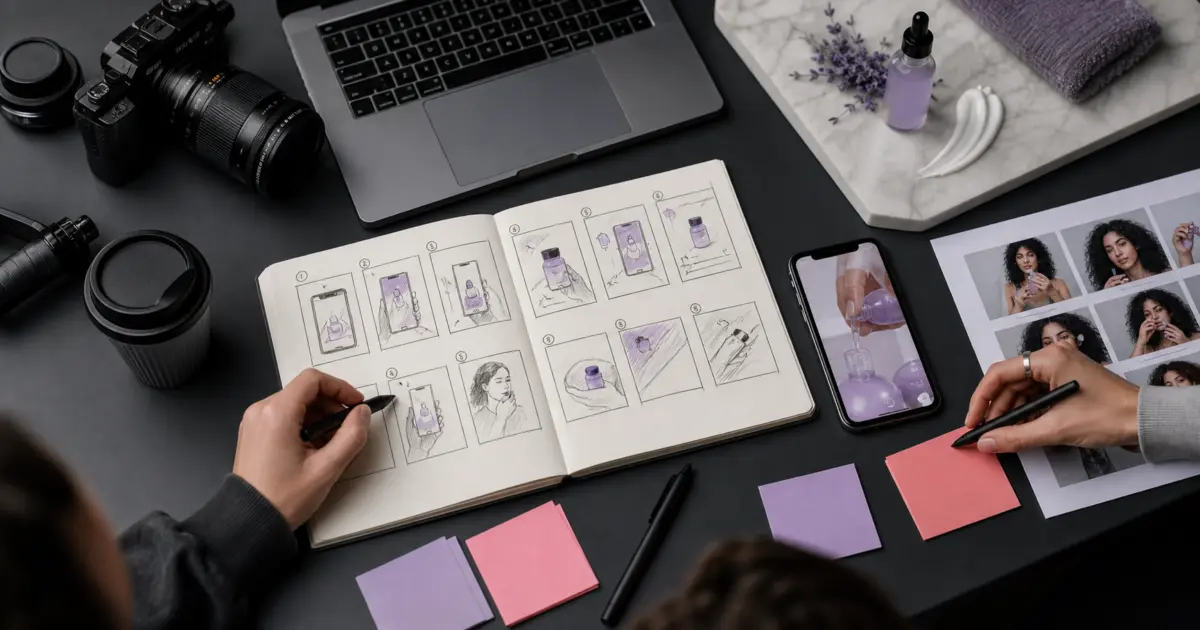
The first two seconds decide everything: your hook either earns the next eight seconds or loses the viewer to the next post, and no production quality recovers a weak open. These ten hooks work because each kills a specific uncertainty or pattern-interrupts the feed — motion openers, bold-claim text, before/after reveals, POV problems, price anchors. With AI generation you can execute every one of them on the same product in an afternoon and let hook rate, not opinion, pick the winner.
- Why the Hook Is the Ad
- The 10 Hooks
- 1. The Blunt Problem Statement
- 2. The Before/After Contrast in Frame One
- 3. The Counterintuitive Claim
- 4. The Specific Number
- 5. The Direct Address
- 6. The Pattern Interrupt
- 7. The Social Proof Stack
- 8. The Demonstration Open
- 9. The Relatable Failure
- 10. The Urgency Anchor
- How to Test These Hooks at Volume
- Matching Hooks to Platforms
- The Execution Rule
- FAQs
- Start Testing
The first two seconds decide everything. On TikTok, Instagram Reels, and Meta vertical placements, your hook either earns the next eight seconds or loses the viewer to the next post. No amount of production quality recovers a weak open.
Here are 10 hooks that actually work on paid social in 2026 — why each one works, and how to execute them fast.
Why the Hook Is the Ad
Most creative teams spend 80% of their time on the middle and end of an ad. The hook gets a few rushed lines. That's backwards.
Platforms reward watch time. If your first two seconds bleed viewers, your CPM climbs and your ROAS drops. The hook is not a warm-up — it is the ad. Everything after it is just the argument for why the viewer made the right call to keep watching.
For DTC brands running $5,000 to $100,000 a month in paid social, the creative bottleneck is almost never the offer. It's volume. You need enough hook variations to test, kill the losers fast, and scale what sticks.
The 10 Hooks
1. The Blunt Problem Statement
Open with the problem, stated plainly. No buildup.
Example: "Your skin is dry because your moisturizer is mostly water."
This works because it names something the viewer already feels but hasn't articulated. The brain snaps to attention when it hears its own frustration said out loud. Keep it specific — vague problems ("tired of bad skincare?") slide past. Precise ones land.
2. The Before/After Contrast in Frame One
Show the "before" state in the first frame. Not described. Shown.
A cluttered desk. A pale, tired face. A leaking water bottle. The viewer recognizes the situation before you say a word. Then the product enters. The contrast does the work.
This format is particularly strong on silent autoplay. The visual communicates before audio kicks in, which matters on Meta placements where many users scroll without sound.
3. The Counterintuitive Claim
Say something that contradicts received wisdom.
Example: "Drinking more water won't fix your hydration problem."
Counterintuitive claims create a small cognitive gap. The viewer needs to close it. That need keeps them watching. The key is that your claim has to be defensible — if the product explanation doesn't pay off the tension, you lose trust. Make sure the claim connects directly to what the product does.
4. The Specific Number
Lead with a number that is oddly specific.
Example: "83% of people wash their face wrong."
Specific numbers feel researched. Round numbers feel made up. "83%" reads as data. "Most people" reads as opinion. The specificity signals credibility before you've said anything about the product.
This hook pairs well with avatar-led ads. An avatar delivers the stat directly to camera, which adds the social proof of a person vouching for the claim.
5. The Direct Address
Speak to a narrow identity.
Example: "If you run a Shopify store and you're still making ads manually, watch this."
You're not trying to reach everyone. You're trying to reach the right person hard. Direct address hooks filter out irrelevant viewers, which actually helps performance — platforms reward engagement signals, and viewers who feel personally addressed engage more.
The narrower the identity, the stronger the hook. "Business owners" is too wide. "DTC founders spending over $10k a month on Meta" is specific enough to make someone stop.
6. The Pattern Interrupt
Open with something visually unexpected for the category.
A skincare brand that opens with a chemistry lab. A supplement brand that opens with a tired parent at 3am. A fashion brand that opens with a factory floor. The unexpected visual breaks the rhythm of the feed.
This is where model quality matters. The visual has to read instantly at 9:16, 720p on a phone screen. Blurry or generic AI video kills the interrupt before it lands.
7. The Social Proof Stack
Open with proof, not pitch.
Example: "47,000 orders. 4.9 stars. Here's why."
You're front-loading credibility. The viewer doesn't need to trust you yet because other people already do. This works especially well for products with genuine traction. Don't fabricate numbers. If the social proof is real, lead with it. If it isn't, use a different hook.
8. The Demonstration Open
Show the product working before you say anything about it.
No voiceover. No text overlay. Just the product doing the thing it does. A knife cutting cleanly. A bag expanding to hold more than expected. A supplement dissolving instantly.
Demonstration hooks bypass skepticism. You're not claiming anything — you're showing it. The viewer draws their own conclusion, which is more persuasive than being told what to think.
9. The Relatable Failure
Open with someone doing the thing wrong.
Example: "I spent $200 on supplements last month and took them all at the wrong time."
This works on identification. The viewer has made the same mistake, or fears making it. The failure creates empathy and positions your product as the correction without being preachy. Avatar delivery matters here — the tone should be self-deprecating, not instructional.
10. The Urgency Anchor
Open with a time or scarcity signal that is specific and believable.
Example: "We're running 600 units of this colorway. 214 left."
Generic urgency ("limited time offer") gets ignored. Specific scarcity gets processed as real information. The viewer has to decide whether to keep scrolling or pay attention. That micro-decision is the hook doing its job.
Use this only when the scarcity is genuine. Fake urgency erodes trust fast on platforms where users see hundreds of ads a week.
How to Test These Hooks at Volume
The problem with hook testing is production time. If each variation takes a day to film, edit, and export, you can test three or four hooks a month at best. That's too slow for meaningful paid social optimization.
AI-generated video changes the math. With product video ads generated from a product link, you can run the full pipeline from URL to finished 9:16 vertical ad without writing a script or sourcing assets manually. The creative brief builds from the product data. Select an avatar, a style, and a hook angle. The video generates.
At roughly $2.44 for an 8-second video using Seedance 2.0 — 349 credits at $0.007 per credit — the cost per variation is low enough to test all 10 formats in a single week's budget. That changes how you approach creative strategy. You stop guessing which hook will win. You test them all and let the data decide.
The v4v model stack covers the full production pipeline: Kling 3.0 and Veo 3.1 for video, Kling AI Avatar for lip sync, Suno for music, HeyGen v2 for translation if you're running multilingual campaigns. Everything runs from one workspace. No tab-switching. No rebuilding assets between variations.
Matching Hooks to Platforms
Not every hook format performs equally across placements.
TikTok rewards the counterintuitive claim and the relatable failure. The platform's culture is built on "things you didn't know" — hooks that teach or reveal something unexpected fit natively.
Instagram Reels responds well to the before/after contrast and the demonstration open. Visual quality reads more on Reels than on TikTok. The demonstration hook in particular benefits from clean motion and sharp product visuals.
Meta feed and stories favor the specific number and the direct address. These placements reach users who are less in discovery mode and more in passive scroll. A specific number or a tight identity call-out snaps them out of autopilot.
The Execution Rule
A strong hook concept with weak execution loses to a decent hook with sharp execution. The frame has to be clean. The text overlay has to be readable in under a second. The audio has to land before the viewer can swipe.
Test one variable at a time. Same product, same offer, different hook. Change the hook and the avatar and the music simultaneously and you won't know what moved the metric.
Generate fast. Kill slow. Scale what works.
Paste a product link. The brief builds itself.
Generate product videos, UGC-style ads and hooks in about 5 minutes.
Try v4vFrom $7 · no subscription, ever · credits never expire
FAQs
What makes a video ad hook effective on paid social in 2026?
A hook works when it creates a reason to keep watching within the first two seconds — naming a specific problem, showing something unexpected, or addressing the viewer's identity directly. Vague or generic openings get scrolled past before the message lands.
How long should a video ad hook be?
The hook itself should resolve within two seconds, sometimes one. The full ad can run 8 to 30 seconds depending on the platform and objective. For TikTok and Reels, shorter ads with strong hooks tend to outperform longer ones in CPM efficiency.
How many hook variations should I test for a single product?
Start with at least three to five distinct hook formats before drawing conclusions. Paid social algorithms need enough data to optimize delivery, and a single hook variant rarely tells you enough about what resonates.
Can AI-generated video work for hook testing at scale?
Yes. AI-generated vertical video at 9:16, 720p is the native format for TikTok, Instagram Reels, and Meta placements. The production cost per variation is low enough to test multiple hook formats in a single week — that's the main advantage over traditional video production.
Which hook format works best for DTC product ads?
The demonstration open and the before/after contrast tend to perform consistently for physical products because they show the product working rather than describing it. The specific number hook works well for supplements, skincare, and health products where claims need credibility signals.
How do I avoid hook fatigue when running multiple variations?
Rotate hook formats rather than just changing copy within the same format. If you've been running problem-statement hooks, shift to demonstration or social proof. Audiences habituate to structural patterns, not just specific words.
What's the fastest way to produce multiple hook variations without a video editor?
Use a product-to-video workflow that generates from a URL. Paste the product link, select different hook angles in the brief, generate each variation. At v4v.ai, the ecommerce workflow handles brief generation, avatar selection, and video output — no manual scripting, no asset sourcing.
Published May 20, 2026 · facts as of publication.