
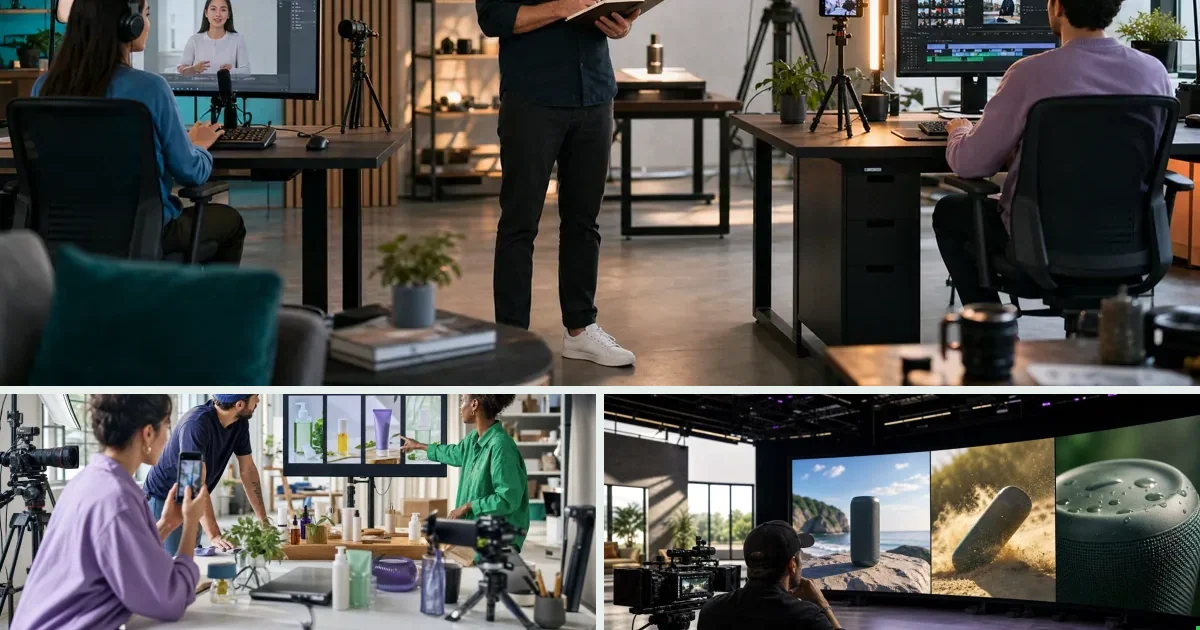
No video team, no shoot scheduled, a vertical ad due Friday — that's now a workable starting point. AI generation has reached the stage where a product link is enough: the platform extracts product data and images, builds the brief, generates the footage (Seedance 2.0 by default), adds voice and music, and outputs a 9:16 ad. This walkthrough covers the URL-to-ad flow step by step, what each model contributes, realistic quality expectations at 720p feed playback, and the ~$2.44-per-video economics.
No video team. No shoot scheduled. Just a product URL and a vertical ad due by end of week.
That's a workable starting point now. AI video generation has reached the point where a product link is enough. No camera, no studio, no footage library required. This article covers exactly how that works — which tools and models do the job, and what the output actually looks like.
Why You Don't Need Footage Anymore
Traditional product video ads needed three things: footage, a script, and an editor. All three cost time and money. Most DTC brands worked around this by filming once and reusing the same clips until performance fell off.
The bottleneck was never ideas. It was production.
AI video generation removes that constraint. Models like Seedance 2.0, Kling 3.0, and Veo 3.1 generate video from images, text prompts, or product data — no existing footage required. You're not editing clips. You're generating new visual output from scratch, starting with whatever product information is already public.
For paid social, this changes the math. TikTok and Meta reward testing volume. More ad variants means faster signal on what converts. A footage dependency kills that velocity.
What AI Actually Does Instead of a Camera
Generating a product video ad without footage involves several things happening in sequence.
The AI reads product data first — images, descriptions, features, pricing context. That's the raw material standing in for a product shoot. From there, it builds a visual narrative: sequencing product visuals, applying motion, adding an avatar or voiceover, and structuring the ad around the first-second hook that paid social demands. The result is a finished file, not a draft or storyboard. A 9:16 vertical video, ready to upload.
The difference between "AI generates random video" and "AI generates a directed product ad" is the workflow. A general text-to-video tool can produce video. A product-specific pipeline produces an ad.
Step-by-Step: From Product Link to Finished Ad
Step 1: Pull Product Data from a URL
Paste your product URL. The platform reads the page and extracts what it needs — product name, images, key features, positioning signals. No manual upload, no copy-pasting descriptions.
This is where the process splits from general AI video tools. Most start with a blank prompt. A product-specific workflow starts with real product data.
Step 2: Let the Brief Build Itself
Once the product data is pulled, a creative brief generates automatically. Hook angle, visual structure, ad format, tone. You can edit any of it — but you're not writing from scratch.
This step removes the biggest time cost in ad production: figuring out what to say and how to frame it before you've touched a single asset.
Step 3: Connect Avatars, Styles, and Assets
Attach an avatar for a UGC-style or spokesperson format. Set the visual style. Connect any brand assets already in the system. If you've run ads on the platform before, your products, avatars, and styles are already saved. Nothing needs to be rebuilt.
That persistence is what separates iteration from starting over. Once your brand assets are in, each new ad begins from a connected state — not a blank slate.
Step 4: Generate the Video
Run the model. Seedance 2.0 handles the URL-to-ad flow by default. An 8-second video costs approximately 349 credits. At the entry tier — $7 for 1,000 credits — that's roughly $2.44 per video.
Output is 9:16, 720p, vertical. Paid social ready.
Which AI Models Actually Matter for Product Ads
Not every video generation model is built for product advertising. Here's what the relevant ones actually do:
Seedance 2.0 — the core model for the URL-to-ad flow. Strong product motion and visual coherence for short-form vertical ads.
Kling 3.0 — image-to-video with motion control. Best when you have a strong product image and want precise visual output.
Veo 3.1 — higher-fidelity generation for scenes that need more visual complexity within the ad format.
Kling AI Avatar — lip sync for avatar-based ads. Matches mouth movement to voiceover for UGC-style formats.
HeyGen v2 — video translation. Converts a finished ad into other languages without a reshoot, useful if you're running across multiple markets.
Suno — generates background music matched to the ad's tone and pacing.
GPT-image-2 and Nano-banana 2 — image editing and generation for product visuals before they enter the video pipeline.
Running all of these from one workspace — no tab-switching, no separate tools — is what makes footage-free production practical at scale.
What You Get: Output Specs That Match Paid Social
The output spec matters as much as the generation quality. A video with the wrong aspect ratio or resolution wastes everything that went into making it.
| Spec | Value |
|---|---|
| Aspect ratio | 9:16 |
| Resolution | 720p |
| Format | Vertical |
| Target channels | TikTok, Instagram Reels, Meta |
9:16 at 720p is the native format for TikTok and Reels. It uploads without cropping, compression artifacts, or platform penalties for wrong dimensions.
How Much Does It Cost Per Video
Credit pricing at v4v.ai is transparent and calculable before you commit.
| Top-up | Credits | Cost per credit |
|---|---|---|
| $7 | 1,000 | $0.00700 |
| $35 | 5,100 | $0.00686 |
| $70 | 10,500 | $0.00667 |
| $300 | 50,000 | $0.00600 |
An 8-second Seedance 2.0 ad costs approximately 349 credits. At the $7 tier, that's $2.44 per video. At the $300 tier, it drops to $2.09.
No subscription. Credits don't expire. Top up once and spend as you go. That's a direct contrast to platforms like Creatify, where credits expire every two months and quality videos on the Starter plan can run $8 to $15 each.
Footage-Free vs. Traditional Production: A Realistic Comparison
| Factor | Traditional production | AI footage-free |
|---|---|---|
| Setup time | Days to weeks | Minutes |
| Per-video cost | $200 to $2,000+ | ~$2.44 at entry tier |
| Variants per session | 1 to 3 | Multiple |
| Reshoot required for new angle | Yes | No |
| Asset reuse across campaigns | Manual | Persistent by default |
The numbers aren't close. For DTC brands running paid social at $5,000 to $100,000 per month, creative production is a real line item. Cutting per-video cost from hundreds of dollars to under $3 changes what's possible in terms of testing volume.
Common Mistakes When Generating Product Videos Without Footage
Using a general text-to-video tool instead of a product-specific workflow. Tools like RunwayML or InVideo AI generate video, but they start from a blank prompt. Without product data extraction and a directed brief, you're writing the ad yourself and hoping the model interprets it correctly.
Skipping the brief. The auto-generated creative brief is where the ad's structure comes from. Accepting defaults without reviewing them — or bypassing the step entirely — produces generic output.
Rebuilding avatars and assets every session. If you're setting up your brand assets from scratch each time, you're losing the main efficiency advantage of a persistent creative system. Set it up once. Let it carry forward.
Generating one variant and stopping. The point of footage-free production is testing velocity. One video tells you almost nothing. Generate three to five variants with different hooks or formats, then let performance data guide the next round.
Mismatching model to format. Seedance 2.0 is optimized for the URL-to-ad flow. Kling 3.0 gives tighter motion control when you're working from a specific product image. Veo 3.1 handles scenes with more visual complexity. The model choice matters.
A product URL is enough to start. The product video ad workflow at v4v.ai handles data extraction, brief generation, model selection, and output format in one workspace. Paste a link. The brief builds itself. Generate.
Paste a product link. The brief builds itself.
Generate product videos, UGC-style ads and hooks in about 5 minutes.
Try v4vFrom $7 · no subscription, ever · credits never expire
FAQs
Can I generate a product video ad with no existing footage or images?
Yes. The URL-to-ad workflow pulls product images and data directly from your product page. No footage upload needed. The AI models generate video from that product data.
What resolution and format does the output use?
9:16 at 720p, vertical. That's the native format for TikTok, Instagram Reels, and Meta placements.
How much does one AI-generated product video cost?
At the entry tier ($7 for 1,000 credits), an 8-second Seedance 2.0 video costs approximately 349 credits — about $2.44. Volume tiers reduce the per-credit cost.
Do I need to reupload my product and brand assets for every new ad?
No. Products, avatars, styles, and assets persist across sessions. Set them up once and they stay connected for every new project.
Which AI model should I use for a standard product ad?
Seedance 2.0 is the default for the URL-to-ad flow and handles most product ad formats well. Kling 3.0 is better when you're working from a specific product image and want tighter motion control. Veo 3.1 suits more visually complex scenes.
Is there a subscription required?
No. Pricing is pay-per-use. Buy a credit top-up and spend as you go. Credits don't expire.
What's the difference between the URL-to-ad flow and the AI Lab?
The URL-to-ad flow is directed: paste a product link, get a brief, generate a finished ad. The AI Lab gives you direct access to individual models — image, video, sound, translation — when you want manual control over each step rather than an automated pipeline.
Published June 6, 2026 · facts as of publication.