
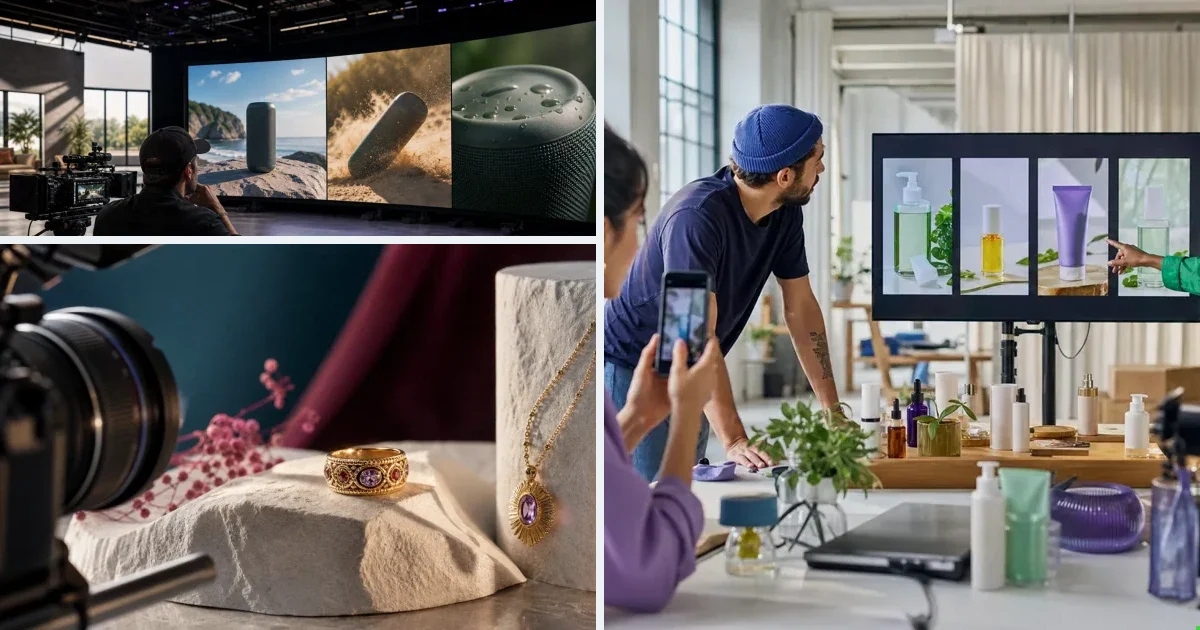
For product ads, these three current-generation models split cleanly by job. Seedance 2.0 is the volume workhorse: clean product-forward motion at ~349 credits (≈$2.44) per 8-second clip — the right default for testing many variants. Kling 3.0 sits a tier up on motion and material fidelity — liquid pours, fabric, reflective surfaces — worth the extra credits when the product is the visual hero. Veo 3.1 is the cinematic option: lighting and depth that read as shot footage, priced for scaling a proven winner, not for exploration. The practical workflow: test angles on Seedance, upgrade the winning concept to Kling or Veo. All three run side-by-side in v4v's AI Lab, so switching is a dropdown, not a new subscription.
Why does model choice matter for product ads?
A paid-social product ad has specific demands: hook in the first second, hold a 9:16 frame, show the product clearly, and render cheaply enough to test multiple angles. General text-to-video benchmarks measure cinematic prompt adherence — not what a DTC brand testing five variants this week actually needs. The relevant questions: how does it handle product-forward scenes, what does an 8-second clip cost, and does motion hold up at scroll speed on a phone?
Seedance 2.0 — fast, reliable, built for volume
- ✓ Consistent motion on product scenes, no artifacts
- ✓ Fast generation; fits test-and-iterate loops
- ✓ ~349 credits ≈ $2.44 per 8-second clip
- ✗ Less suited to dramatic camera moves, skin texture, cinematic depth-of-field
It's the default in v4v's product-ad workflow for a reason: generate variants cheaply, find what works, then spend premium credits only on winners.
Kling 3.0 — motion quality and material fidelity
- ✓ Physically plausible motion: pours, fabric, texture reveals
- ✓ Strong on reflective surfaces and product highlights
- ✓ Image-to-video preserves product detail from a reference photo
- ✓ Motion-copy: reuse a winning motion pattern across SKUs
- ✗ Higher cost per clip; faces need separate lip-sync (Kling AI Avatar)
Worth it when the product must be the hero — a serum catching light, a sneaker rotating, a slow-motion pour. Beauty, food, and apparel ads live here.
Veo 3.1 — cinematic output for high-stakes creative
- ✓ Photorealistic lighting and natural depth
- ✓ Lifestyle scenes where the product lives in the real world
- ✗ Priced for scaling winners, not high-volume testing
The right call after Seedance found the angle that drives ROAS and you want the best version of that ad carrying real budget.
Head-to-head for product-ad jobs
| Job | Seedance 2.0 | Kling 3.0 | Veo 3.1 |
|---|---|---|---|
| High-volume variant testing | Best | OK | Costly |
| Product-on-surface showcase | Best value | Better fidelity | Overkill |
| Liquid / fabric / texture shots | OK | Best | Strong |
| Lifestyle / in-context scenes | OK | Strong | Best |
| Cost per 8-sec clip | ~$2.44 | Higher | Highest |
What this comparison can't tell you
Model output varies by product category and prompt. The honest answer for your product is an A/B: run the same brief on two models and compare. In v4v's Lab that's two generations — a few dollars, not two subscriptions.
Run all three on your product — side by side
Same prompt, three models, one workspace. Keep the winner.
Open the AI LabFrom $7 · pay per video, never per seat
FAQs
Which model is cheapest for product video ads?
Seedance 2.0 — an 8-second clip runs ~349 credits, about $2.44 at v4v's entry pack ($7 for 1,000 credits).
Which model is best for beauty or food ads?
Kling 3.0 — its motion fidelity on liquids, fabric and reflective surfaces is the differentiator for those categories.
Do I need separate subscriptions to use all three?
No. v4v runs Seedance 2.0, Kling 3.0 and Veo 3.1 in one workspace on the same credit balance.
Facts checked July 16, 2026. Model versions and credit costs change; this page is refreshed when they do.