
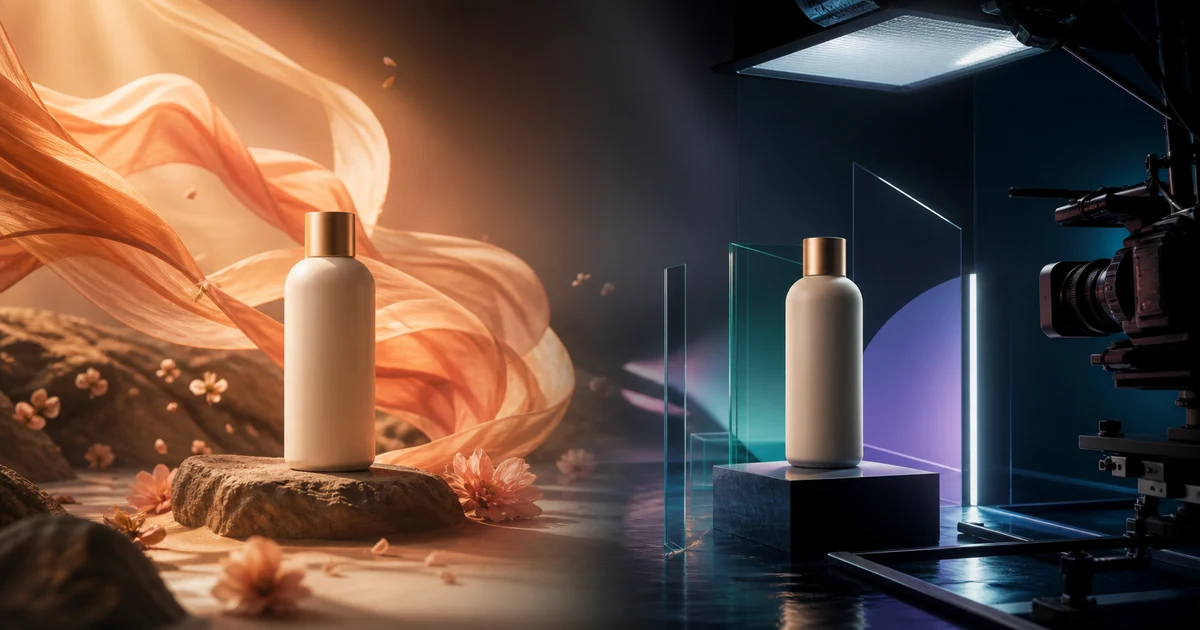
Studio benchmark: 198 credits per 10-second video, at 720p or 1080p, in 9:16 or 16:9. About $1.39 on the $7 pack or $1.19 on the $300 pack. Lab models and Workflows vary; check the estimate before you run.
TL;DR — updated October 1 2026
Wan 2.7 and Kling 3.0 are both capable AI video generation models, but they serve different creative needs in an ecommerce ad pipeline. Wan 2.7 produces fluid, naturalistic motion that works well for lifestyle and product-in-use footage. Kling 3.0 delivers sharper subject fidelity and more controlled camera movement, making it stronger for product-hero shots and structured ad formats. Neither is universally better — the right choice depends on your ad format, product category, and how your production pipeline is built. Both models are available inside v4v.ai's AI Lab, where you can run them individually or embed them in a reusable workflow without switching tools.
What Each Model Actually Does
These two models are optimized for different things at a technical level, and that difference shows up directly in ad output.
Wan 2.7 is a diffusion-based video generation model built for high-motion, high-realism scenes. It handles complex motion paths, fluid transitions, and environmental detail well. Its weakness is frame-to-frame subject consistency — small product details like text, logos, and packaging can drift across a longer clip. Try the Wan 2.7 prompts for product motion and lifestyle scenes.
Kling 3.0 is Kuaishou's latest video generation model, built with a stronger emphasis on subject-consistent generation and camera control. When you need a product to stay centered, well-lit, and visually stable across the full clip duration, Kling 3.0 is more predictable. The Kling 3.0 prompt examples focus on materials, weight and controlled motion.
Both are text-to-video and image-to-video capable. Both output in formats suitable for vertical 9:16 paid social. The differences show up in specific use cases — and that's where the choice actually matters.
According to Wyzowl's 2024 State of Video Marketing report, 91% of businesses use video as a marketing tool, and short-form product video consistently ranks as the format with the highest reported ROI. The model you choose determines whether that video holds up under scrutiny.
Motion Quality: Where Wan 2.7 Has an Edge
For ads that require dynamic, lifestyle-style footage, Wan 2.7 produces more convincing motion. A skincare product being applied, a bag lifted off a table, a drink being poured — the motion feels physical rather than mechanical. That's a meaningful step up from earlier generation models.
This matters because product-in-use footage consistently outperforms static hero shots in direct response. The visual cue of someone interacting with a product triggers a different kind of attention than a product sitting on a surface. Research from Meta's own creative guidance has consistently pointed to motion in the first three seconds as a driver of thumb-stop rate — Meta's internal data shows that mobile video ads with movement in the first 1.5 seconds drive 89% more completions.
Wan 2.7's strength is generating that sense of physical reality without source footage. For DTC brands without a film budget, that's a real capability.
The trade-off: Wan 2.7 can introduce drift in longer clips. For a 6-second hook, this is rarely a problem. For a 15-second structured ad with product close-ups, it can require additional iteration before the output is usable.
Subject Fidelity: Where Kling 3.0 Has an Edge
Kling 3.0 is more reliable when the product itself needs to be the visual anchor. Product-hero shots, before/after comparisons, ads where packaging needs to stay legible — Kling 3.0 holds subject consistency better across frames.
This is particularly relevant for supplements, electronics, and packaged food, where the product's physical appearance is part of the purchase signal. A label that blurs or a color that shifts between cuts reads as low-quality to the viewer, even subconsciously. That perception affects conversion.
Kling 3.0 also follows camera movement directives more predictably. A slow push-in on a product, a rack focus from background to foreground — Kling 3.0 executes those instructions with less deviation than Wan 2.7 in most cases.
As AI video researcher Fabian Offert noted in a 2024 analysis of diffusion-based video models: "Subject consistency across frames remains the central unsolved problem in video generation — models that sacrifice motion realism to solve it tend to produce more commercially usable outputs." Kling 3.0's design reflects exactly that trade-off.
Ad Format Fit: Matching the Model to the Brief
The practical question for a DTC performance marketer is not which model scores higher on a benchmark. It's which model fits the specific ad format you're building.
Use Wan 2.7 for:
- Lifestyle and product-in-use clips
- Hook sequences that need high-energy motion
- Background or B-roll footage where exact product detail is secondary
- Ads where environmental realism sells the product — apparel, home goods, food
Use Kling 3.0 for:
- Product-hero shots and close-up detail sequences
- Structured ad formats with defined camera moves
- Categories where packaging legibility matters — supplements, beauty, tech
- Any clip where subject consistency across frames is non-negotiable
The strongest ad accounts in 2026 are running both, using each for the specific clip type it handles best, then assembling them in a single production pipeline.
Speed and Cost in a Real Production Pipeline
Model quality only matters if you can generate at volume. A model that produces marginally better output but costs significantly more per generation, or takes three times as long, will slow your creative testing cadence — and cadence is what makes paid social competitive.
Both Wan 2.7 and Kling 3.0 are available inside v4v.ai's AI Lab. The platform runs on a pay-per-use credit system with no subscription. Credit packs start at $7 for 1,000 credits, and credits don't expire. For reference, a 10-second Studio video costs approximately 198 credits — roughly $1.39 at the entry pack rate. Wan 2.7 and Kling 3.0 generation costs vary by clip length, but the same per-credit pricing applies across the full model stack.
If you're running 20 to 50 ad variants per week, that cost structure matters more than which model scores slightly higher on a quality benchmark. The goal is volume with acceptable quality, not perfection at low volume.
According to a 2024 HubSpot survey, marketers who produce more than 10 video assets per month report 2.5x higher ad performance scores than those producing fewer than five. Volume is the variable. The model is just the tool.
For a broader look at how AI video fits into a full ecommerce creative strategy, the complete guide to AI product video ads covers format selection, funnel stage matching, and production cadence in detail.
Turn your product page into a video in under 5 minutes →
Running Both Models in One Workspace
The practical advantage of using v4v.ai is not having to pick one model and commit to it. The AI Lab lets you run Wan 2.7, Kling 3.0, Veo 3.1, Seedance 2.0, and other models individually across image, video, and sound tasks. The Workflows builder lets you create reusable pipelines that route specific clip types to the model best suited for them.
For a DTC brand running product ads at scale, that means: lifestyle hook clips routed to Wan 2.7, product-hero sequences routed to Kling 3.0, avatar voiceover handled by Kling AI Avatar with lip sync, and music from Suno — all within a single production session.
Products, avatars, styles, and assets persist across sessions. You're not rebuilding context every time you start a new batch. That persistent context is where the real time saving accumulates.
Real-World Output: What to Expect
Neither model is perfect. Both require iteration, particularly on the first few generations for a new product or style direction.
Wan 2.7 needs tighter prompts when you want controlled motion. Vague prompts produce interesting but unpredictable results. Specific prompts — camera angle, motion direction, lighting condition, subject behavior — produce more usable outputs on the first or second attempt.
Kling 3.0 rewards structured camera directives. "Slow push-in, product centered, soft studio lighting" produces more consistent results than "show the product looking good." The more specific the brief, the more predictable the output.
For practical evidence of what AI-generated video ads can achieve in a real account, the breakdown of 5 AI product video ad campaigns that drove real results covers specific approaches and what changed in performance when creative volume increased.
The Verdict for Ecommerce Ads
Wan 2.7 wins on motion realism and lifestyle footage. Kling 3.0 wins on subject fidelity and structured camera control. For most ecommerce ad accounts, the answer is to use both.
The brands generating the most creative volume in 2026 are not debating which single model to standardize on. They're building pipelines that route each clip type to the right model, generating at high volume, and letting performance data decide what to scale.
If you're still choosing one tool and one model, you're one step behind the production cadence that makes paid social competitive. v4v.ai gives you access to both models, plus the full pipeline from product URL to finished 9:16 ad — no subscription required.
v4v Shopify App
The v4v Shopify app is live on the Shopify App Store: pick a product in Shopify admin, preview the clip, and publish it to the product page. Three videos free on install.
Paste a product link. The brief builds itself.
Generate product videos, UGC-style ads and hooks in about 5 minutes.
From $7 · no subscription, ever · credits never expire
FAQs
What is the main difference between Wan 2.7 and Kling 3.0 for product ads?
Wan 2.7 produces more fluid, naturalistic motion and works well for lifestyle and product-in-use footage. Kling 3.0 maintains stronger subject consistency and handles structured camera movements more predictably, making it better suited for product-hero shots and ads where packaging detail needs to stay legible across the full clip.
Can I use both Wan 2.7 and Kling 3.0 in the same production pipeline?
Yes. Both models are available in v4v.ai's AI Lab. You can run them individually for specific clip types or build a reusable Workflow that routes different creative tasks to each model automatically.
Which model is better for TikTok and Meta vertical ads?
Both output in formats suitable for 9:16 vertical ads. For high-motion TikTok hooks, Wan 2.7 tends to produce more engaging results. For Meta product catalog ads where visual accuracy matters, Kling 3.0 is generally more reliable.
How much does it cost to generate a video with these models on v4v.ai?
The platform runs on a pay-per-use credit system with no subscription. Credit packs start at $7 for 1,000 credits, and credits never expire. For reference, a 10-second Studio video costs approximately 198 credits — roughly $1.39 at the entry rate. Wan 2.7 and Kling 3.0 generation costs follow the same per-credit pricing structure.
Do I need to choose one model and commit to it?
No. The strongest approach for ecommerce ad production is to use each model for the clip type it handles best — Wan 2.7 for motion-heavy lifestyle footage, Kling 3.0 for product-centered structured shots. v4v.ai's Workflows builder lets you automate that routing across a full production pipeline. Model selection is not the constraint. Production volume is. Pick the right model for each clip type, build a pipeline that runs both, and let the performance data tell you what to scale.