
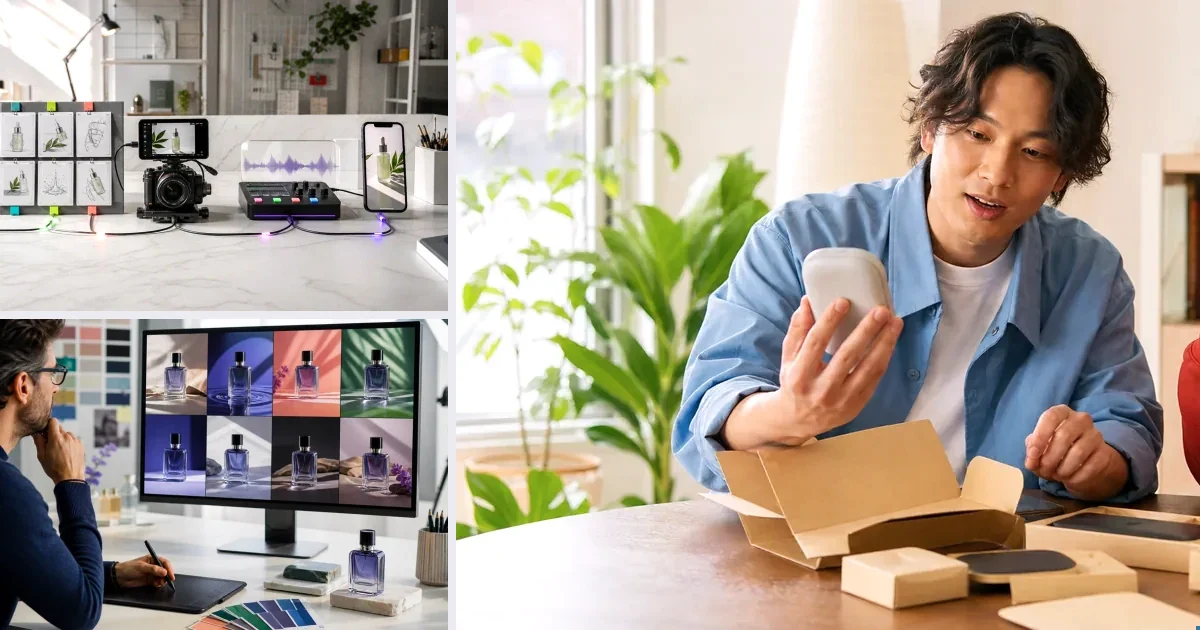
An AI creative workspace is a single environment that runs multiple generation models — video, image, music, voice, lip sync, translation — with shared context and one billing relationship. The alternative it replaces: five browser tabs, five subscriptions, and manual file-shuttling between a video generator, an image editor, a music tool and a translation service. Marketers are switching because ad production is a chain (image → video → music → localization), and chains break at the seams between tools. In one workspace the seams disappear: v4v's Lab, for example, runs Seedance 2.0, Kling 3.0, Veo 3.1, Wan 2.7, GPT-image-2, Nano-banana 2, Suno and HeyGen v2 on one pay-per-use balance.
What qualifies as a workspace (vs. a tool)
- Multiple model categories under one roof — not one engine with presets
- Shared assets/context — the product you imported is available to every model
- One cost meter — a credit balance that all generations draw from
- Chained outputs — an image edit feeds a video generation feeds a translation, without export/import
The economic argument
Five specialist subscriptions at $20–$100/month each is $100–$500/month of idle capacity for a team that produces in bursts. A workspace on pay-per-use converts that fixed cost into marginal cost — you pay when you produce.
For the workflow and cost tradeoffs, see our practical comparison of an AI creative studio versus single-purpose AI tools.
Paste a product link. The brief builds itself.
Generate product videos, UGC-style ads and hooks in about 5 minutes.
Try v4vFrom $7 · no subscription, ever · credits never expire
FAQs
Is an AI creative workspace the same as a creative suite?
Close cousins — "suite" usually means many separate tools from one vendor; a workspace shares context and billing across models in one flow.
Who needs one?
Teams producing recurring short-form creative: DTC operators, performance marketers, agencies with multiple client SKUs.
Facts checked July 16, 2026. Competitor claims from public pricing pages; verify before relying on them.