
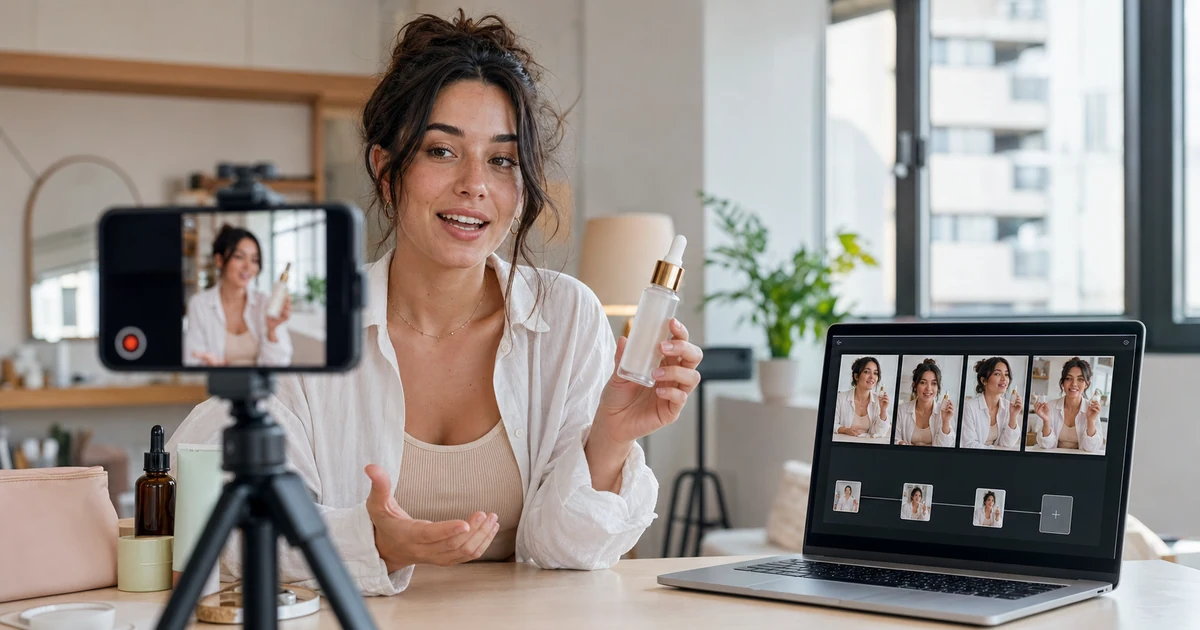
You no longer need a creator marketplace to run UGC-style ads on TikTok. The working loop: pick one hook, write a sub-50-word script that sounds like speech, choose an avatar with believable lip sync, generate from your product URL, layer on captions and native sound, then test three-plus variations and let hook rate decide. The economics drive the shift — 2026 rate guides put newer human creators at $150–$300 per video before usage rights, while an 8-second AI clip runs about $2.44 on v4v. In one merchant's test posted to r/ecommerce in July 2026 — a single shop's result, not an industry study — short AI demo clips converted the same as phone-shot ones. Real creators still win for Spark Ads whitelisting and brand storytelling; for paid testing volume, AI is now the default.
- What Makes a TikTok UGC Ad Actually Work?
- Step 1: Pick the Hook Before You Open Any Tool
- Step 2: Write a Script That Sounds Like a Person
- Step 3: Choose an Avatar and Check the Lip Sync
- Step 4: Generate the Video From Your Product URL
- Step 5: Add the Native TikTok Layer
- Step 6: Test Variations Like a Media Buyer
- Step 7: Review Before You Publish
- What Does AI UGC Cost Compared With Hiring Creators?
- Where Do Real Creators Still Beat AI?
- FAQs
- Start Generating
UGC-style ads are still the workhorse format on TikTok for one reason: they look like the feed, not like ads. The format was never the problem. Production was. Finding creators, briefing them, waiting on revisions, then doing it all again for every new angle — that loop eats weeks, and published 2026 rate guides put newer creators at $150–$300 per video before usage rights even enter the invoice.
AI collapses that loop into an afternoon. Here's the exact workflow I use — product URL to ready-to-run vertical ad — plus where the human pass still matters, and where real creators still win.
What Makes a TikTok UGC Ad Actually Work?
Before touching any tool, know what you're imitating. High-performing UGC ads share four traits:
- A hook that resolves in two seconds. A question, a blunt claim, a frustration named out loud. If the open doesn't earn the next second, nothing after it matters.
- Talking, not announcing. The person on screen sounds like they're telling a friend about a thing they bought. Zero press-release language.
- One message. One product, one benefit, one call to action. Scripts that say everything convert nothing.
- Native texture. 9:16 framing, captions, imperfect lighting, a handheld feel. It should read like it was shot on a phone — because on TikTok, phone-shot is the trust signal.
The best generation pipeline in the world won't rescue a weak concept. Nail these first.
Step 1: Pick the Hook Before You Open Any Tool
Write down three to five candidate hooks before you generate anything. Formats that keep working on TikTok:
- Problem-first: "I burned $300 a month on ads that died in a week — until this."
- Reaction: "Okay, I didn't expect this thing to actually work."
- Listicle tease: "Three things nobody tells you before you buy a standing desk."
- Direct claim: "This is the only serum I've repurchased three times."
The hook is the highest-leverage creative decision in the whole ad. We keep a longer breakdown of 10 hooks that stop the scroll if you want the full menu.
Step 2: Write a Script That Sounds Like a Person
The script decides whether the finished video feels like UGC or like a robot cosplaying a customer. Write for the ear: short sentences, contractions, a pause or two. Read it aloud once — the stiff parts announce themselves.
Budget words to length. For an 8-to-15-second test cut, you get roughly 30–45 words: hook, one claim, CTA. Done. For a longer 30-to-45-second story ad, the classic structure still holds:
- Hook (0–3s): stop the scroll.
- Problem (3–10s): why this matters to the viewer.
- Product (10–20s): introduced like a discovery, not a pitch.
- Proof (20–35s): what changed, with a specific number if you have one.
- CTA (35–45s): one action. "Link in bio." Not three.
Start with the short cut. It's cheaper to test and forces the message down to one claim.
Step 3: Choose an Avatar and Check the Lip Sync
This is where the UGC illusion gets built or broken. Three filters when picking a presenter:
- Demographic match. The avatar should look like your buyer. People trust people who resemble them.
- Energy. Calm-and-credible sells supplements; caffeinated enthusiasm sells gadgets. Match tone to product.
- Language. Running multiple markets? Check translation support before you commit to a face.
Lip sync is the make-or-break detail — a half-second drift between mouth and audio reads as fake instantly. v4v handles this with Kling AI Avatar lip sync, and HeyGen v2 translation (175+ languages) covers localization when a winning ad needs to travel.
Step 4: Generate the Video From Your Product URL
Script written, avatar picked — now the fast part. On v4v, the flow starts from a link, not a blank canvas:
- Paste your product URL. The system pulls the name, images, and selling points.
- The creative brief builds itself from that data — or drop in your own script.
- Pick the avatar and style. Output is 9:16 at 720p, native to TikTok.
- Generate, preview, regenerate the weak takes.
An 8-second clip on Seedance 2.0 costs 349 credits — about $2.44 at the $7 entry pack rate. Credits are one-time purchases and never expire, so a slow month costs you nothing. Products, avatars, and styles persist across sessions, which is what makes variation two take minutes instead of another setup. The step most people dread — sourcing and timing B-roll — simply doesn't exist in this flow.
Step 5: Add the Native TikTok Layer
Raw output is a starting point. The details that make it read as TikTok-native:
- Captions. A large share of viewers watch with sound off. No captions, no message.
- On-screen text. Short callouts that land as the avatar speaks — one claim per card.
- Sound. An ambient or trending-style track under the voice. Silence feels broken on TikTok.
- A cut or two. Even one mid-video cut resets attention and lifts watch time.
Full framing rules — safe zones, sound-off design, why cropped horizontal footage fails — are in our vertical video ads guide.
Step 6: Test Variations Like a Media Buyer
One video is not a strategy. Build at least three versions per concept, changing one variable at a time:
- Hook variation: same script body, different opening line.
- Avatar variation: same script, different presenter.
- Format variation: same message as a testimonial, then as a listicle.
Run them simultaneously in TikTok Ads Manager with equal budgets. After 48–72 hours the data separates: hook rate tells you which open holds, click-through tells you which presenter sells. Kill the losers, scale the winner, spin the next round.
At ~$2.44 a clip, ten variations cost under $25 — this is the entire economic argument for AI UGC. Testing ten angles with human creators is a four-figure line item; with generation it's an afternoon. One merchant's test posted to r/ecommerce in July 2026 is worth knowing here: in that single shop's test — not an industry study — 8-to-10-second product demo videos lifted PDP conversion by roughly 12%, and the AI-generated clips performed the same as phone-shot ones.
Step 7: Review Before You Publish
Fast production still needs a human pass. Two minutes of checking saves real ad spend:
- Lip sync: does every line track the mouth naturally?
- Names and numbers: did the voice mangle your product name or invent a claim?
- Product accuracy: right colorway, right packaging, nothing warped.
- Compliance: TikTok's ad policies for your category — and its rules on synthetic media. Per TikTok's published synthetic-media policy, realistic AI-generated content should carry the AIGC disclosure label. Use the toggle; don't gamble on a takedown.
What Does AI UGC Cost Compared With Hiring Creators?
| Method | Cost per video | Turnaround |
|---|---|---|
| UGC creator (newer, per 2026 rate guides) | ~$150–$300 + 30–50% for usage rights | Days to weeks |
| Established UGC creator | Often $400+ per video | Days to weeks |
| v4v (8s clip, Seedance 2.0) | ~$2.44 — 349 credits at the $7/1,000 pack | Minutes |
Creator rates vary widely by niche and follower count — treat the ranges as listed figures from public 2026 rate guides, not gospel. The structural difference holds regardless: creators price per deliverable and per revision; generation prices per render, and the full cost map shows how that changes testing math at every budget level.
Where Do Real Creators Still Beat AI?
Honest limits, because pretending there aren't any is how you waste a quarter:
- Spark Ads and whitelisting. Running paid through a real creator's handle inherits their profile, their comments, their credibility. AI can't fake an account with history. If Spark Ads are core to your strategy, you need humans.
- Hands-on product demos. Texture, unboxing, actual use in a real kitchen — physical handling still reads more convincingly from a person holding the thing.
- Brand storytelling. Long-form narrative, community in-jokes, creator affinity. AI tests claims; humans build relationships.
- Comment-section trust. Some audiences will ask "is this AI?" — with disclosure labels, sooner than you think. For brand-building content, that friction matters more than it does for cold-traffic testing.
The practical split most teams land on: AI for volume testing on cold traffic, real creators for scaling proven angles and UGC formats where authenticity is the entire pitch.
Paste a product link. The brief builds itself.
Generate product videos, UGC-style ads and hooks in about 5 minutes.
Try v4vFrom $7 · no subscription, ever · credits never expire
FAQs
What are TikTok UGC ads?
Paid ads formatted to look like organic user-generated content — someone talking to camera in a casual, personal style instead of a polished brand video. They perform because they blend into the feed people came to watch.
Can AI-generated videos pass as real UGC on TikTok?
At normal scroll speed on a phone, good AI avatars with clean lip sync are hard to clock as synthetic. The bigger tell is the script: a realistic avatar reading stiff marketing copy still feels like an ad. Note that TikTok's published synthetic-media policy requires realistic AI-generated content to be labeled — use the AIGC disclosure toggle.
How long should a TikTok UGC ad be?
Shorter than most people write them. For cold-traffic testing, 8 to 15 seconds — one hook, one claim, one CTA — is enough to read hook rate and click-through. Longer 30-to-45-second story formats earn their length only after a short version has proven the angle.
How many variations should I create per campaign?
At least three per concept, changing one variable at a time — hook first, then avatar, then format. Run them simultaneously with equal budget, give TikTok Ads Manager 48 to 72 hours, cut the losers, and scale the winner.
Is AI video production cheaper than hiring UGC creators?
Substantially, at testing volume. Published 2026 rate guides put newer UGC creators at roughly $150–$300 per video, with usage rights often adding 30–50% on top. AI generation on v4v runs about $2.44 for an 8-second Seedance 2.0 clip, so ten test variations cost less than $25. Real creators still win for Spark Ads whitelisting and brand storytelling.
Published July 26, 2026 · Facts checked July 31, 2026. Competitor claims from public pricing pages; verify before relying on them.